US Digital Accessibility Laws: Prepare by November 2026

US Digital Accessibility Laws: What US Websites Need to Change by November 2026 (TIME-SENSITIVE)
The digital world is constantly evolving, and with it, the legal framework governing online accessibility. For businesses operating in the United States, the clock is ticking. A significant deadline looms: November 2026. By this time, US websites will need to comply with updated digital accessibility laws, ushering in a new era of inclusivity and legal responsibility. Ignoring these changes is not an option, as non-compliance can lead to costly lawsuits, reputational damage, and, most importantly, the exclusion of a significant portion of the population.
This comprehensive guide will delve into the upcoming digital accessibility laws, their implications for US websites, and the crucial steps you need to take to ensure your online presence is compliant and accessible to everyone. We’ll explore the historical context, the specifics of the new regulations, and practical strategies for implementation, all designed to help you navigate this complex landscape successfully.
The Evolving Landscape of Digital Accessibility Laws
For years, the concept of web accessibility has been guided by various acts and standards. The Americans with Disabilities Act (ADA), though enacted in 1990, predates the internet as we know it. However, its principles of non-discrimination have been consistently applied to the digital realm through court interpretations and Department of Justice (DOJ) guidance. Similarly, Section 508 of the Rehabilitation Act of 1973 mandates that federal agencies’ electronic and information technology be accessible to people with disabilities. While these have provided a foundation, the digital landscape has become exponentially more complex, necessitating clearer, more specific regulations for the private sector.
The upcoming changes by November 2026 are not a sudden development but rather a culmination of years of advocacy, legal precedent, and technological advancements. The goal is to harmonize existing interpretations and establish clear, enforceable standards that reflect the current state of digital interaction. This move aims to provide greater clarity for businesses and stronger protections for individuals with disabilities, ensuring they have equal access to online goods, services, and information.
Why November 2026 is a Critical Deadline
The specific deadline of November 2026 is critical because it represents the culmination of a period of transition and the full enforcement of updated regulations. While the exact details of all forthcoming changes are continuously refined, the general direction points towards a stronger adoption and enforcement of the Web Content Accessibility Guidelines (WCAG) 2.1 Level AA as the de facto standard for private sector websites. This date allows businesses a reasonable timeframe to assess their current accessibility, plan necessary changes, and implement them thoroughly. However, given the potential scope of work, starting early is imperative.
Failure to meet this deadline can result in significant legal and financial repercussions. Lawsuits pertaining to web accessibility have been on the rise, and with clearer guidelines, the burden of proof for non-compliance may become easier for plaintiffs to establish. Beyond legal risks, businesses that fail to prioritize accessibility risk alienating a substantial market segment – individuals with disabilities and their families, who possess considerable purchasing power and influence.
Understanding the Core of Digital Accessibility: WCAG 2.1 Level AA
At the heart of most digital accessibility laws, both existing and upcoming, are the Web Content Accessibility Guidelines (WCAG). Developed by the World Wide Web Consortium (W3C), WCAG provides a globally recognized set of recommendations for making web content more accessible to a wide range of people with disabilities. The upcoming requirements are largely expected to solidify WCAG 2.1 Level AA as the benchmark for US websites.
WCAG is structured around four main principles, often remembered by the acronym POUR:
- Perceivable: Information and user interface components must be presentable to users in ways they can perceive. This means providing text alternatives for non-text content, captions for audio/video, and ensuring content can be presented in different ways without losing information or structure.
- Operable: User interface components and navigation must be operable. This includes making all functionality available via keyboard, providing enough time for users to read and use content, and designing content to avoid causing seizures or physical reactions.
- Understandable: Information and the operation of user interface must be understandable. This involves making text readable and understandable, making web pages appear and operate in predictable ways, and helping users avoid and correct mistakes.
- Robust: Content must be robust enough that it can be interpreted reliably by a wide variety of user agents, including assistive technologies. This means maximizing compatibility with current and future user agents.
WCAG 2.1 builds upon WCAG 2.0 by adding success criteria that address mobile accessibility, low vision, and cognitive disabilities. Achieving Level AA compliance means meeting a significant number of these criteria, ensuring a high level of accessibility for most users.
Key WCAG 2.1 Level AA Success Criteria to Focus On
While a full list of WCAG 2.1 Level AA criteria is extensive, here are some critical areas that often require attention and will be central to the upcoming digital accessibility laws:
- Text Alternatives (1.1.1 Non-text Content): All non-text content (images, charts, graphs, videos without audio description) must have a text alternative that serves the equivalent purpose. This is crucial for screen reader users.
- Keyboard Navigation (2.1.1 Keyboard): All functionality of the content must be operable through a keyboard interface without requiring specific timings for individual keystrokes. This is vital for users who cannot use a mouse.
- Time-based Media (1.2.1 Audio-only and Video-only (Prerecorded), 1.2.2 Captions (Prerecorded), 1.2.3 Audio Description or Media Alternative (Prerecorded)): Provide alternatives for time-based media, including captions for videos and audio descriptions for visual content in videos.
- Color Contrast (1.4.3 Contrast (Minimum)): Ensure a minimum contrast ratio of 4.5:1 for regular text and 3:1 for large text. This helps users with low vision or color blindness.
- Resizable Text (1.4.4 Resize text): Users must be able to resize text up to 200 percent without loss of content or functionality.
- Headings and Labels (2.4.6 Headings and Labels): Headings and labels should be descriptive and clear. Semantic HTML is key here.
- Focus Order (2.4.3 Focus Order): If a web page can be navigated sequentially, and the navigation sequences affect meaning or operation, focusable components receive focus in an order that preserves meaning and operability.
- Link Purpose (2.4.4 Link Purpose (In Context)): The purpose of each link can be determined from the link text alone or from the link text together with its programmatically determined link context.
- Error Identification (3.3.1 Error Identification): If an input error is automatically detected, the item in error is identified and the error is described to the user in text.
- Labels or Instructions (3.3.2 Labels or Instructions): Labels or instructions are provided when content requires user input.
- Consistent Navigation (3.2.3 Consistent Navigation): Navigational mechanisms that are repeated on multiple web pages within a set of web pages occur in the same relative order each time they are repeated, unless a change is initiated by the user.
Who Will Be Affected by the New Digital Accessibility Laws?
The short answer is: nearly every US website. While federal agencies and those receiving federal funding have long been subject to Section 508, the upcoming regulations are expected to solidify and broaden the application of accessibility requirements to private businesses under the ADA.
Specifically, businesses that:
- Are places of public accommodation: This includes a vast array of businesses, from retail stores and restaurants to hotels, healthcare providers, and educational institutions. If your physical location is considered a public accommodation, your website, as a virtual extension of that business, is likely subject to the same accessibility requirements.
- Engage in interstate commerce: Businesses that conduct transactions or provide services across state lines will also fall under the purview of these laws.
- Have a significant online presence: Any business that relies heavily on its website for customer interaction, sales, or information dissemination should consider itself impacted.
Even small businesses, often mistakenly believing they are exempt, may find themselves subject to these requirements, especially if their website serves as a primary point of contact or transaction for the public. The trend in legal interpretations is towards greater inclusion, making it prudent for all businesses to proactively address digital accessibility laws.
Proactive Steps to Ensure Compliance by November 2026
Meeting the November 2026 deadline requires a strategic, multi-faceted approach. It’s not a one-time fix but an ongoing commitment. Here are the essential steps:
1. Conduct a Comprehensive Accessibility Audit
The first step is to understand your current accessibility posture. A thorough audit involves both automated tools and manual testing. Automated tools can quickly identify common issues like missing alt text or insufficient color contrast. However, they only catch a fraction of accessibility problems. Manual testing, performed by accessibility experts and actual users with disabilities, is crucial to uncover more complex issues related to keyboard navigation, screen reader compatibility, and overall user experience.
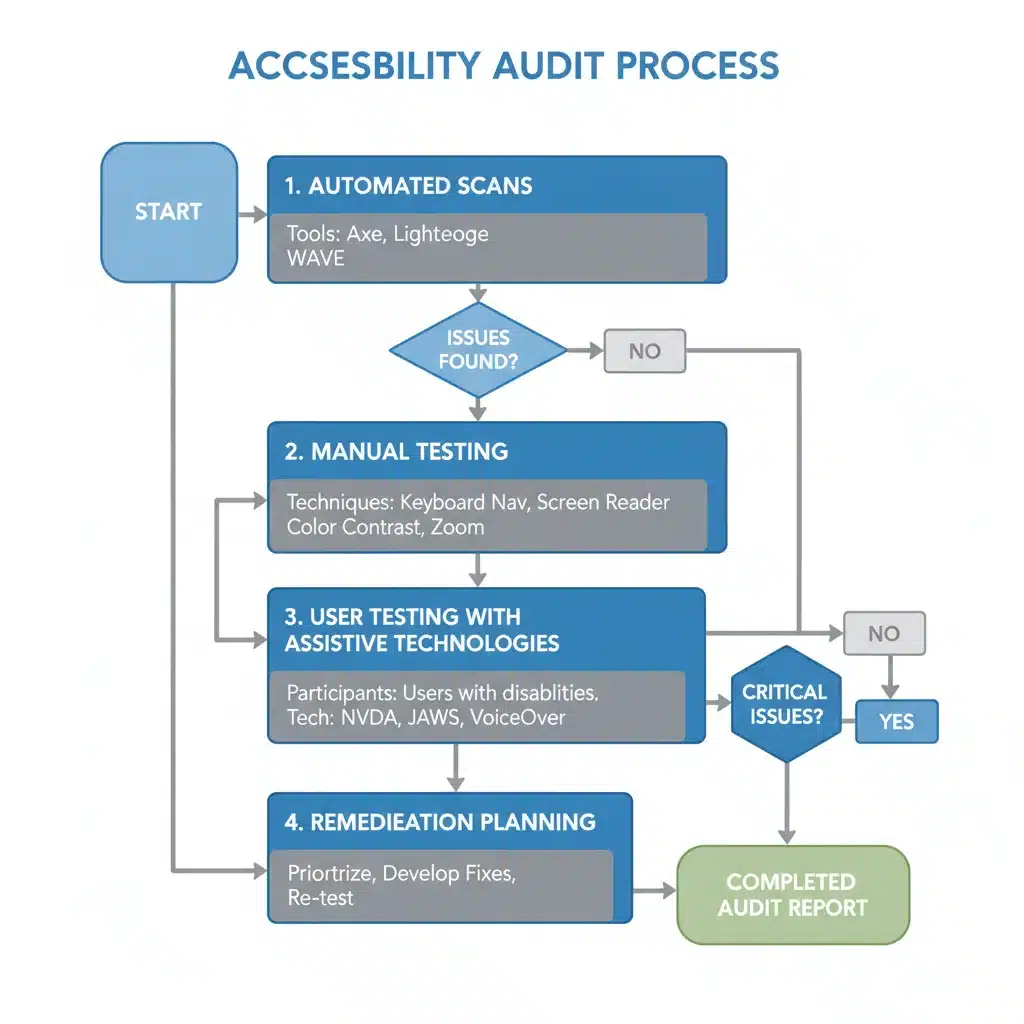
An audit should cover:
- Automated Scans: Utilize tools like axe-core, Lighthouse, or WAVE.
- Manual Review: Experts review your site against WCAG 2.1 Level AA criteria.
- Keyboard Testing: Ensure all interactive elements are operable via keyboard alone.
- Screen Reader Testing: Test with popular screen readers (e.g., JAWS, NVDA, VoiceOver) to experience the site as a visually impaired user would.
- Color Contrast Analysis: Verify compliance with contrast ratios.
- Form Accessibility: Ensure all form fields have proper labels and error handling.
- Multimedia Accessibility: Check for captions, transcripts, and audio descriptions.
2. Develop an Accessibility Remediation Plan
Based on your audit findings, create a detailed remediation plan. This plan should prioritize issues based on their severity and impact on users, allocating resources and setting realistic timelines. It’s essential to integrate accessibility fixes into your regular development cycles rather than treating them as a separate, one-off project.
Key elements of the plan:
- Prioritization: Address critical issues (e.g., keyboard traps, missing alt text on crucial images) first.
- Resource Allocation: Assign specific teams or individuals to implement fixes.
- Timeline: Set clear deadlines for each phase of remediation, keeping the November 2026 deadline in mind.
- Tools and Technologies: Identify any new tools or technologies needed to support accessibility.
3. Implement Accessibility Enhancements
This is where the actual work happens. Your development and content teams will need to implement the changes identified in the remediation plan. This might involve:
- Code Adjustments: Ensuring semantic HTML, proper ARIA attributes, and accessible JavaScript.
- Content Updates: Adding alt text to images, providing transcripts for audio, captions for video, and clear, concise language.
- Design Modifications: Adjusting color palettes for better contrast, ensuring sufficient spacing, and designing intuitive navigation.
- Third-Party Integrations: If you use third-party widgets, plugins, or services, ensure they are also accessible or choose accessible alternatives. This is a common overlooked area.
4. Train Your Team
Accessibility is everyone’s responsibility. Provide ongoing training for your design, development, content, and quality assurance teams. They need to understand accessibility principles, how to implement them in their daily work, and how to test for them. This fosters a culture of accessibility within your organization, ensuring that future digital products are built with accessibility in mind from the outset.
5. Implement an Accessibility Statement and Feedback Mechanism
A clear accessibility statement on your website demonstrates your commitment to inclusivity. This statement should outline the accessibility standards you adhere to, the measures you’ve taken to ensure accessibility, and any known limitations. Crucially, it should also include a clear and easily accessible feedback mechanism (e.g., an email address, phone number, or contact form) for users to report accessibility issues. This not only shows good faith but also provides valuable insights for continuous improvement and can even serve as a mitigating factor in legal disputes.
6. Ongoing Monitoring and Maintenance
Digital accessibility is not a static state; it requires continuous monitoring and maintenance. As your website evolves with new content, features, and design updates, new accessibility barriers can inadvertently be introduced. Regular audits, automated checks, and user testing should be part of your ongoing operational procedures to ensure sustained compliance with digital accessibility laws.

Benefits Beyond Compliance: The Business Case for Accessibility
While compliance with digital accessibility laws is a legal imperative, the benefits extend far beyond avoiding lawsuits. Investing in accessibility is a smart business decision that can lead to:
- Expanded Market Reach: Approximately 1 in 4 adults in the US (61 million people) live with a disability. Making your website accessible opens your services and products to this significant and often underserved market.
- Improved SEO: Many accessibility best practices align directly with good SEO practices. For example, semantic HTML, clear heading structures, alt text for images, and transcripts for videos all improve how search engines crawl and index your site, leading to better search rankings.
- Enhanced User Experience for All: Features designed for people with disabilities often benefit all users. Captions help in noisy environments, clear navigation benefits those with cognitive load, and keyboard accessibility helps power users.
- Stronger Brand Reputation: Companies that demonstrate a commitment to inclusivity and social responsibility build stronger, more positive brand images. Being known as an accessible brand can be a significant differentiator.
- Reduced Legal Risk: Proactive compliance significantly reduces the risk of expensive and time-consuming lawsuits and settlements.
- Innovation: Focusing on accessibility can spur innovation in how you design and develop digital products, leading to more creative and robust solutions.
Common Pitfalls and How to Avoid Them
As businesses rush to meet the November 2026 deadline for digital accessibility laws, several common mistakes can derail their efforts:
- Relying Solely on Automated Tools: Automated checkers are a great starting point but cannot detect all accessibility issues, especially those related to context, user experience, and more complex interactions. Manual testing is essential.
- Treating Accessibility as an Afterthought: Retrofitting accessibility is always more expensive and time-consuming than building it in from the start. Integrate accessibility into your design and development workflows from day one.
- Ignoring Third-Party Content: Many websites rely on third-party widgets, plugins, or embedded content (e.g., social media feeds, video players). If these are not accessible, your entire site can be deemed non-compliant. Vet all third-party tools for accessibility.
- Lack of Internal Buy-in and Training: Without commitment from leadership and proper training for all relevant teams, accessibility efforts will falter.
- Forgetting Mobile Accessibility: With a significant portion of web traffic coming from mobile devices, ensuring your mobile site or app is accessible is just as crucial as your desktop version. WCAG 2.1 specifically addresses mobile accessibility.
- No Continuous Monitoring: Websites are dynamic. New content, features, or updates can introduce new accessibility barriers. A one-time audit is not enough; ongoing monitoring is vital.
- Misinterpreting Legal Requirements: The legal landscape can be complex. Consulting with legal counsel specializing in digital accessibility is advisable to ensure your understanding of the digital accessibility laws is accurate and up-to-date.
Looking Ahead: The Future of Digital Accessibility
The November 2026 deadline for updated digital accessibility laws is just one milestone in an ongoing journey towards a truly inclusive digital world. As technology advances, so too will the expectations and requirements for accessibility. Artificial intelligence, virtual reality, and other emerging technologies will present new challenges and opportunities for ensuring equal access.
Businesses that embrace accessibility now will not only meet legal obligations but also position themselves as leaders in innovation and corporate social responsibility. They will be better prepared for future regulatory changes and will have cultivated a loyal customer base that values inclusivity.
The move towards clearer and more enforceable digital accessibility laws reflects a societal shift towards recognizing digital access as a fundamental right. By proactively preparing for November 2026, US websites can ensure they are not just compliant, but also genuinely welcoming and usable for everyone.
Conclusion
The upcoming November 2026 deadline for US digital accessibility laws represents a pivotal moment for businesses. It’s a call to action to review, revise, and reinforce your website’s accessibility features. By understanding the core principles of WCAG 2.1 Level AA, conducting thorough audits, implementing strategic remediation plans, and fostering an organizational culture of accessibility, businesses can not only avoid potential legal pitfalls but also unlock significant market opportunities and enhance their brand reputation.
Don’t wait until the last minute. The time to act is now. Start your accessibility journey today to ensure your website is a beacon of inclusivity by November 2026, serving all users equitably and effectively.