Supply Chain Resilience: US Strategies for 6-Month Mitigation

Building robust supply chain resilience is paramount for US companies, requiring immediate implementation of advanced strategies to navigate and mitigate potential disruptions over the next six months, safeguarding operational stability and market competitiveness.
In an increasingly interconnected yet volatile global economy, the imperative for US companies to bolster their supply chain resilience has never been more urgent. The past few years have unveiled vulnerabilities, from geopolitical tensions to natural disasters and pandemics, underscoring the need for robust, adaptive strategies. This article explores updated approaches US businesses can implement to significantly mitigate disruptions over the next six months, transforming challenges into opportunities for sustained growth and operational stability.
Understanding the evolving landscape of supply chain risks
The global supply chain environment is in a constant state of flux, presenting businesses with a myriad of complex and unpredictable risks. Traditional risk assessment models often fall short in capturing the dynamic nature of these threats, necessitating a more holistic and forward-looking approach. US companies must first acknowledge the multifaceted nature of these risks to effectively build resilience.
These risks are no longer confined to single points of failure but rather manifest as systemic vulnerabilities across entire networks. Geopolitical shifts, for instance, can introduce sudden trade barriers or sanctions, while climate change exacerbates the frequency and intensity of natural disasters, impacting production and transportation hubs. Moreover, the increasing reliance on digital infrastructure introduces cyber threats, capable of paralyzing operations and compromising sensitive data. Understanding these interconnected risks is the foundational step towards developing effective mitigation strategies.
Identifying key risk categories
- Geopolitical Instability: Trade wars, tariffs, and international conflicts can severely disrupt sourcing and market access.
- Environmental Factors: Extreme weather events, climate change impacts, and resource scarcity directly affect raw material availability and logistics.
- Technological Vulnerabilities: Cyberattacks, data breaches, and system failures pose significant threats to operational continuity and intellectual property.
- Economic Volatility: Inflation, currency fluctuations, and recessions influence demand, pricing, and investment in supply chain infrastructure.
Beyond these external pressures, internal operational inefficiencies can also contribute to fragility. Lack of visibility into sub-tier suppliers, inadequate inventory management, and rigid operational processes can amplify the impact of external shocks. A comprehensive understanding of both external and internal risk factors is crucial for developing a truly resilient supply chain. This involves continuous monitoring and analysis of global events, coupled with internal audits to identify and address bottlenecks before they escalate into crises.
In conclusion, the current risk landscape demands a paradigm shift from reactive problem-solving to proactive risk management. US companies must invest in sophisticated risk intelligence tools and cultivate a culture of continuous learning and adaptation. By doing so, they can anticipate potential disruptions and implement preventative measures, thus safeguarding their supply chains from unforeseen challenges.
Leveraging data analytics and AI for predictive insights
In the quest for enhanced supply chain resilience, data analytics and artificial intelligence (AI) have emerged as indispensable tools. These technologies offer unprecedented capabilities for predictive insights, allowing companies to anticipate disruptions before they materialize and respond with greater agility. The sheer volume of data generated across modern supply chains, from production lines to shipping routes and consumer demand, provides a rich source for analysis.
AI-driven platforms can process and interpret this data at speeds and scales impossible for human analysis, identifying subtle patterns and correlations that signal potential issues. For instance, by analyzing weather patterns, geopolitical news, and supplier performance metrics, AI can forecast potential delays or shortages, providing critical lead time for decision-makers. This proactive capability shifts supply chain management from a reactive firefighting exercise to a strategic, forward-looking discipline.
Implementing advanced analytics platforms
- Demand Forecasting: AI models can analyze historical sales data, market trends, and external factors to predict future demand with higher accuracy.
- Risk Prediction: Machine learning algorithms can identify potential disruptions by monitoring news feeds, weather reports, and supplier network data.
- Inventory Optimization: Predictive analytics help maintain optimal inventory levels, reducing carrying costs while preventing stockouts during disruptions.
- Route Optimization: AI can suggest alternative shipping routes in real-time, bypassing congested or high-risk areas to ensure timely delivery.
The integration of AI also extends to automating routine tasks, freeing up human resources to focus on more strategic initiatives. For example, AI can automate order processing, track shipments, and even manage supplier communications, improving efficiency and reducing the likelihood of human error. This automation not only streamlines operations but also enhances the overall responsiveness of the supply chain.
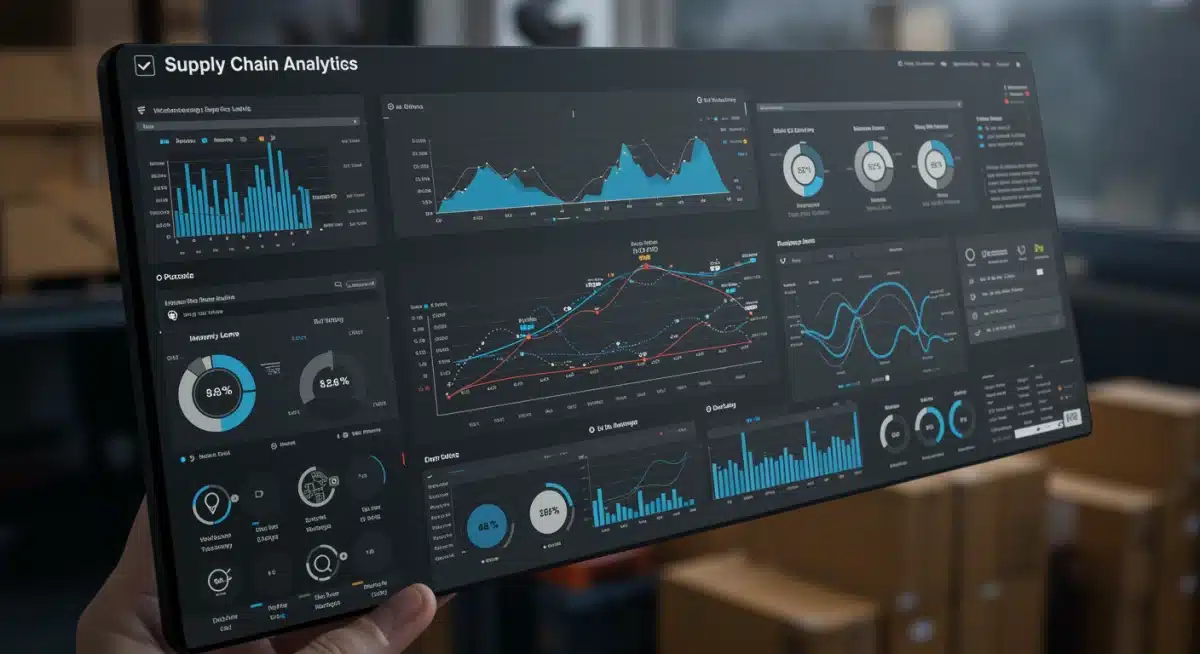
Furthermore, AI-powered systems can simulate various disruption scenarios, allowing companies to test the robustness of their supply chain strategies in a virtual environment. These simulations provide invaluable insights into potential weak points and help refine response plans, ensuring that when real disruptions occur, the company is well-prepared. The ability to model and prepare for multiple contingencies is a cornerstone of modern supply chain resilience.
Ultimately, leveraging data analytics and AI transforms raw data into actionable intelligence, empowering US companies to make informed decisions that strengthen their supply chains. By embracing these technologies, businesses can move beyond traditional reactive approaches, building a more resilient, efficient, and future-proof operational framework capable of navigating the complexities of the modern global economy.
Diversifying sourcing and manufacturing locations
One of the most effective strategies for enhancing supply chain resilience is the strategic diversification of sourcing and manufacturing locations. Over-reliance on a single region or supplier, while sometimes offering cost efficiencies, dramatically increases vulnerability to localized disruptions. The recent past has vividly demonstrated how events in one part of the world can ripple through global supply chains, causing widespread shortages and delays.
By spreading production and sourcing across multiple geographic regions, US companies can build redundancy into their operations. If one region experiences a disruption, alternative sources or manufacturing sites can step in, ensuring continuity of supply. This approach not only mitigates risk but also fosters greater flexibility and responsiveness to market changes. It’s about not putting all your eggs in one basket, particularly in a world where global stability is increasingly uncertain.
Strategies for effective diversification
- Regional Hubs: Establish manufacturing or sourcing hubs in different continents or economic blocs to minimize exposure to single-region risks.
- Dual Sourcing: Identify and qualify multiple suppliers for critical components, ensuring that if one fails, another can quickly take its place.
- Nearshoring/Reshoring: Explore bringing some production closer to home (nearshoring) or back to the US (reshoring) to reduce lead times and geopolitical exposure.
- Supplier Network Mapping: Gain deep visibility into sub-tier suppliers to understand the full extent of your supply chain and identify concentration risks.
Diversification is not merely about adding more suppliers; it’s about strategically building a network that is robust against various types of shocks. This involves a thorough assessment of potential new locations, considering factors such as political stability, labor costs, infrastructure quality, and logistical capabilities. Companies must also evaluate the total cost of ownership, which includes not just purchase price but also transportation, inventory holding, and potential risk mitigation costs.
Furthermore, building strong relationships with diverse suppliers is critical. This involves clear communication, shared risk management strategies, and collaborative planning. A truly diversified supply chain is one where partners are integrated and aligned, working together to overcome disruptions rather than being isolated points of failure. This collaborative approach enhances overall network strength.
In essence, diversifying sourcing and manufacturing locations transforms a fragile, single-point-of-failure system into a resilient, multi-point network. While it may require initial investment and careful planning, the long-term benefits in terms of reduced risk, increased stability, and enhanced operational continuity far outweigh the costs. For US companies, this strategy is a cornerstone of building enduring supply chain resilience in a turbulent global landscape.
Strengthening supplier relationships and collaboration
Beyond geographical diversification, the quality and strength of relationships with suppliers play a pivotal role in enhancing supply chain resilience. A transactional approach to supplier engagement, focused solely on cost, often leaves companies vulnerable during times of crisis. Instead, fostering deep, collaborative partnerships can create a shared sense of responsibility and improve collective response capabilities.
When companies invest in their supplier relationships, they gain greater transparency into their partners’ operations, early warnings about potential issues, and a willingness from suppliers to go the extra mile during disruptions. This collaborative spirit transforms suppliers from mere vendors into integral extensions of the company’s own operations, working in unison towards common goals of stability and efficiency.
Key elements of strong supplier collaboration
- Information Sharing: Establish robust channels for sharing critical data, including demand forecasts, inventory levels, and production schedules, enabling proactive adjustments.
- Joint Risk Assessment: Collaborate on identifying and mitigating potential risks, developing joint contingency plans for various disruption scenarios.
- Long-term Contracts: Implement long-term agreements that provide stability and incentives for suppliers to invest in their capabilities and loyalty.
- Performance Feedback: Provide regular, constructive feedback and support for continuous improvement, fostering a culture of excellence.
Building trust takes time and consistent effort. It involves fair dealings, timely payments, and mutual respect. Companies that treat their suppliers as true partners are more likely to receive preferential treatment, such as expedited orders or allocation of scarce resources, when supply chains are under pressure. This preferential treatment can be the deciding factor in maintaining operational continuity during a crisis.
Moreover, collaborative relationships extend beyond direct suppliers to their sub-tier networks. By working with primary suppliers to gain visibility into their own upstream partners, companies can uncover hidden risks and ensure that resilience extends throughout the entire value chain. This multi-tiered approach to collaboration is essential for comprehensive risk management.
In summary, strengthening supplier relationships is not just good business practice; it is a critical component of building resilient supply chains. By moving beyond purely transactional interactions to genuine partnerships, US companies can create a network of allies ready to adapt and overcome disruptions together. This collaborative ecosystem is far more capable of weathering storms than a collection of isolated entities, ultimately securing a more stable future for all involved.
Implementing agile and flexible operational models
The ability to adapt quickly to unforeseen circumstances is a hallmark of strong supply chain resilience. Rigid, inflexible operational models are easily broken when confronted with disruptions, whereas agile systems can pivot and reconfigure themselves to maintain functionality. For US companies, embracing agility means moving away from static, optimized-for-efficiency designs towards dynamic, responsive structures.
An agile supply chain is characterized by its capacity to absorb shocks, recover rapidly, and even thrive amidst volatility. This requires not only flexible processes but also a culture that encourages rapid decision-making, continuous learning, and cross-functional collaboration. It’s about building an organizational muscle that can quickly shift gears, whether it’s rerouting shipments, adjusting production schedules, or reallocating resources.
Pillars of agile supply chain operations
- Modular Design: Design products and processes with modularity in mind, allowing for easier substitution of components or production steps.
- Flexible Manufacturing: Invest in manufacturing technologies that can be quickly reconfigured to produce different products or adjust volumes.
- Dynamic Inventory Management: Move beyond fixed inventory levels to dynamic strategies that adapt to real-time demand and supply signals.
- Cross-functional Teams: Create empowered, cross-functional teams capable of making rapid decisions and implementing changes without extensive hierarchical approvals.
Adopting an agile mindset also involves a willingness to experiment and embrace new technologies. For instance, additive manufacturing (3D printing) can provide on-demand production capabilities, reducing reliance on traditional supply chains for certain parts. Robotics and automation can also enhance flexibility, allowing for quicker changes in production lines and reduced labor dependency.
Furthermore, establishing clear communication protocols and decision-making frameworks is crucial for quick response. During a crisis, ambiguity can lead to paralysis. Agile organizations have pre-defined escalation paths and empowered individuals who can make swift, informed decisions, minimizing downtime and mitigating impact. This clarity ensures that everyone knows their role and responsibilities when disruption strikes.
In conclusion, implementing agile and flexible operational models is fundamental for US companies aiming to build robust supply chain resilience. By fostering adaptability in processes, technology, and organizational culture, businesses can transform their supply chains into dynamic entities capable of not just surviving disruptions but emerging stronger and more competitive. This strategic shift is essential for navigating the unpredictable landscape of modern global commerce.
Enhancing cybersecurity and digital infrastructure
As supply chains become increasingly digitized and interconnected, the importance of robust cybersecurity and resilient digital infrastructure cannot be overstated. A cyberattack on any part of the supply chain, from a supplier’s IT system to a logistics provider’s network, can have cascading effects, disrupting operations, compromising data, and eroding trust. For US companies, protecting their digital assets is now an integral part of maintaining supply chain resilience.
The rise of sophisticated cyber threats, including ransomware, phishing, and state-sponsored attacks, demands a proactive and multi-layered defense strategy. It’s not enough to secure one’s own systems; companies must also ensure that their partners and vendors adhere to stringent cybersecurity standards. A weak link anywhere in the digital chain can expose the entire network to significant vulnerabilities.
Pillars of digital supply chain security
- Endpoint Protection: Secure all devices, from laptops to IoT sensors, that connect to the supply chain network.
- Network Segmentation: Isolate critical systems to prevent the lateral movement of threats in case of a breach.
- Vendor Risk Management: Conduct thorough cybersecurity assessments of all third-party vendors and integrate security clauses into contracts.
- Employee Training: Regularly train employees on cybersecurity best practices to minimize human error, a common entry point for attacks.
Beyond defensive measures, investing in resilient digital infrastructure is equally important. This includes cloud-based solutions that offer scalability and redundancy, ensuring that critical data and applications remain accessible even if local systems are compromised. Disaster recovery plans, including regular data backups and rapid restoration capabilities, are also essential for minimizing downtime after an attack.
Furthermore, continuous monitoring of digital ecosystems for suspicious activity is crucial. Advanced threat detection systems, leveraging AI and machine learning, can identify anomalies in network traffic or user behavior that may indicate an impending or ongoing attack. Rapid detection allows for swift containment and remediation, preventing minor incidents from escalating into major crises.
In conclusion, enhancing cybersecurity and digital infrastructure is a non-negotiable component of building comprehensive supply chain resilience for US companies. By adopting a proactive, multi-layered security approach and investing in resilient digital foundations, businesses can protect their operations from the growing threat of cyberattacks, ensuring the integrity and continuity of their supply chains in an increasingly digital world.
Building a culture of continuous improvement and adaptation
Ultimately, achieving lasting supply chain resilience is not a one-time project but an ongoing journey rooted in a culture of continuous improvement and adaptation. The global landscape is constantly evolving, and what works today may not be sufficient tomorrow. For US companies, this means fostering an organizational mindset that embraces change, learns from disruptions, and proactively seeks ways to enhance capabilities.
A culture of continuous improvement encourages every level of the organization to identify inefficiencies, experiment with new solutions, and share best practices. It moves beyond simply reacting to problems and instead focuses on systemic enhancements that prevent future issues. This proactive stance ensures that the supply chain is not just robust but also continuously evolving to meet new challenges.
Elements of an adaptive supply chain culture
- Leadership Buy-in: Strong commitment from leadership to prioritize resilience and allocate necessary resources.
- Employee Empowerment: Empowering employees to identify risks, propose solutions, and take ownership of resilience initiatives.
- Regular Review and Audit: Conduct periodic reviews of supply chain strategies and performance, identifying areas for improvement.
- Knowledge Sharing: Establish mechanisms for sharing lessons learned from disruptions and successful mitigation strategies across departments and with partners.
Learning from past disruptions, both internal and external, is a critical aspect of this culture. Post-mortem analyses of incidents can reveal systemic weaknesses and provide valuable insights for future planning. This includes not only what went wrong but also what went right, allowing successful strategies to be replicated and integrated into standard operating procedures.
Moreover, embracing technological advancements and innovative practices is key to adaptation. This involves staying abreast of emerging technologies, such as blockchain for transparency or advanced robotics for automation, and assessing their potential to further enhance supply chain resilience. A willingness to pilot new solutions and scale successful ones is vital for remaining competitive.
In essence, building a culture of continuous improvement and adaptation transforms the supply chain into a living, learning system. It ensures that US companies are not just prepared for the next disruption but are actively evolving to become more robust, efficient, and responsive over time. This ongoing commitment to excellence is the true foundation of enduring supply chain resilience in an unpredictable world.
| Key Strategy | Brief Description |
|---|---|
| Data & AI Integration | Utilize predictive analytics and AI to anticipate disruptions and optimize operations. |
| Diversified Sourcing | Spread production and suppliers across multiple regions to reduce single-point failure risks. |
| Strong Supplier Relations | Foster collaborative partnerships for enhanced transparency and joint risk mitigation. |
| Agile Operations | Implement flexible models for quick adaptation to unforeseen market changes and disruptions. |
Frequently asked questions about supply chain resilience
Supply chain resilience refers to a company’s ability to anticipate, withstand, and recover from disruptions. For US companies, it’s crucial because global interconnectivity exposes them to various unforeseen events, from natural disasters to geopolitical conflicts, directly impacting operations and profitability. Building resilience ensures business continuity and competitive advantage in a volatile world.
Data analytics, especially when powered by AI, provides predictive insights into potential disruptions. By analyzing vast datasets—including weather patterns, supplier performance, and market trends—companies can forecast demand, identify risks, and optimize inventory. This proactive approach allows for informed decision-making and rapid response, significantly mitigating the impact of unforeseen events.
Supplier diversification minimizes reliance on a single source or region, thereby reducing vulnerability to localized disruptions. By establishing multiple sourcing and manufacturing locations globally, companies build redundancy into their supply chains. If one source is compromised, alternative options can quickly fill the gap, ensuring continuous supply and operational stability.
Strong, collaborative supplier relationships foster transparency, trust, and shared risk management. Partners are more likely to provide early warnings of issues and prioritize your needs during crises. This collaborative ecosystem ensures better communication, joint problem-solving, and a unified front against disruptions, moving beyond transactional interactions to strategic alliances.
Fostering a culture of continuous improvement involves leadership commitment, employee empowerment, and regular performance reviews. It encourages learning from past disruptions, embracing new technologies, and adapting strategies proactively. This ongoing commitment ensures the supply chain remains dynamic, robust, and capable of evolving to meet future challenges, making resilience an ingrained organizational trait.
Conclusion
The journey toward robust supply chain resilience is an ongoing strategic imperative for US companies, not a temporary fix. As global complexities continue to mount, those businesses that proactively invest in data-driven insights, diversify their networks, strengthen supplier partnerships, implement agile operations, and fortify their digital infrastructure will be best positioned to thrive. By embedding a culture of continuous improvement and adaptation, companies can transform potential disruptions into opportunities for innovation and sustained competitive advantage, securing their future in an ever-changing world.