US Cloud Computing Trends: A Deep Dive into 2026 Dominators
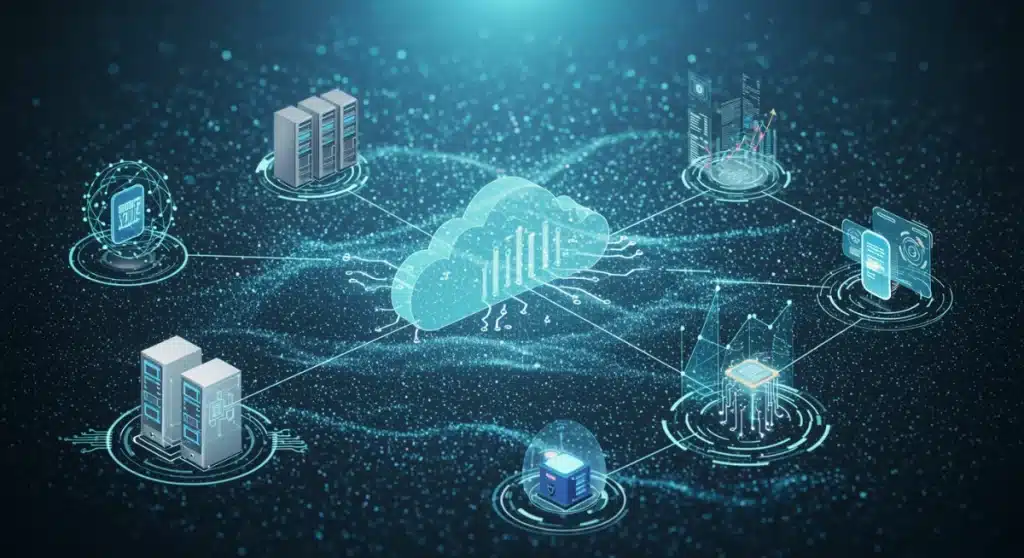
The US cloud computing landscape in 2026 will be shaped by four pivotal trends: hybrid and multi-cloud strategies, pervasive edge computing, advanced AI integration, and the rise of sovereign cloud solutions, fundamentally transforming digital infrastructure.
The digital realm is in constant flux, and understanding the forces shaping its future is crucial for businesses and innovators. This US cloud computing trends analysis delves into the four major shifts poised to dominate the landscape in 2026, offering a clear perspective on what lies ahead.
The rise of hybrid and multi-cloud strategies
Hybrid and multi-cloud architectures are no longer just buzzwords; they represent a fundamental evolution in how organizations manage their IT infrastructure. As businesses seek greater flexibility, resilience, and cost optimization, these strategies are becoming indispensable, allowing for a tailored approach to data and application deployment.
The ability to blend public cloud services with private cloud environments, or to leverage multiple public cloud providers simultaneously, offers unparalleled agility. This approach enables organizations to place workloads where they make the most sense, whether for performance, compliance, or security reasons. The complexity of managing these diverse environments is giving rise to sophisticated orchestration tools and platforms.
Optimizing workload placement
Strategic workload placement is a core driver behind hybrid and multi-cloud adoption. Companies are meticulously evaluating which applications and data sets reside in which environment to maximize efficiency and minimize latency.
- Data sovereignty: Keeping sensitive data within a private cloud or specific geographic region to meet regulatory requirements.
- Performance: Deploying compute-intensive applications closer to end-users or specific data sources.
- Cost efficiency: Leveraging the most cost-effective cloud provider for different types of workloads.
- Disaster recovery: Distributing applications and data across multiple clouds to enhance resilience.
This nuanced approach ensures that resources are utilized optimally, providing a competitive edge in a rapidly changing market. The decision-making process often involves detailed analysis of application dependencies, data gravity, and security postures across various cloud environments.
Challenges and solutions in multi-cloud management
While offering significant advantages, hybrid and multi-cloud environments present their own set of challenges, particularly around governance, security, and operational complexity. Managing disparate platforms requires specialized skills and robust tooling.
To address these challenges, organizations are investing in unified management platforms that provide a single pane of glass for monitoring, managing, and securing their entire cloud footprint. These platforms often incorporate AI-driven analytics to automate routine tasks, identify potential issues, and optimize resource allocation.
In conclusion, the shift towards hybrid and multi-cloud strategies underscores a demand for adaptable and resilient infrastructure. Businesses are seeking to harness the best of all cloud worlds, balancing innovation with control and compliance, making these architectures central to their 2026 IT roadmaps.
Pervasive edge computing
Edge computing, the practice of processing data closer to its source rather than sending it to a centralized cloud or data center, is rapidly moving from niche application to mainstream adoption. This trend is driven by the explosion of IoT devices, the need for real-time data processing, and the imperative to reduce latency in critical operations. By 2026, edge computing will be deeply integrated into various sectors, transforming how data is generated, analyzed, and acted upon.
The benefits of edge computing are clear: faster response times, reduced bandwidth consumption, and enhanced security for sensitive data. Industries such as manufacturing, healthcare, and retail are particularly poised to benefit, as they rely heavily on immediate insights from distributed sensors and devices. The convergence of 5G networks with edge infrastructure is accelerating this adoption, enabling seamless connectivity and robust data processing capabilities at the periphery of the network.
Edge computing’s impact on industries
The implications of pervasive edge computing span across numerous industries, fundamentally altering operational models and customer experiences. From smart factories to autonomous vehicles, the ability to process data locally unlocks new possibilities.
- Manufacturing: Real-time monitoring of machinery for predictive maintenance, optimizing production lines, and ensuring quality control.
- Healthcare: Remote patient monitoring, faster diagnosis through AI at the edge, and secure data processing for medical devices.
- Retail: Personalized in-store experiences, inventory management, and fraud detection through on-site video analytics.
- Smart Cities: Traffic management, public safety, and environmental monitoring with immediate data analysis.
These applications demonstrate how edge computing facilitates immediate decision-making, improving efficiency and safety across diverse operational environments. The decentralized nature of edge processing also enhances data privacy by keeping sensitive information localized.
Challenges in deploying and managing edge infrastructure
Despite its promise, the deployment and management of edge computing environments present unique challenges. The distributed nature of edge devices requires robust security measures, efficient device management, and seamless integration with cloud backends.
Organizations must contend with securing a vast number of endpoints, ensuring consistent software updates, and orchestrating data flows between the edge and the cloud. Solutions are emerging in the form of specialized edge orchestration platforms, AI-powered security protocols, and simplified deployment tools that streamline the management of distributed infrastructure.
In summary, edge computing is set to become a foundational component of digital infrastructure, enabling real-time intelligence and localized data processing. Its pervasive adoption will redefine operational efficiency and drive innovation across a multitude of industries by 2026, making it a critical trend in the US cloud computing trends landscape.
Advanced AI integration in cloud services
Artificial intelligence (AI) is no longer a standalone technology but an integral component of cloud services, profoundly impacting how businesses operate and innovate. By 2026, advanced AI capabilities will be deeply embedded across all layers of the cloud stack, from infrastructure management to application development. This integration will make AI more accessible, scalable, and powerful, democratizing its use for a wider range of organizations.
Cloud providers are continually enhancing their AI offerings, providing sophisticated machine learning platforms, pre-trained models, and AI-powered development tools. This allows businesses to leverage AI without significant upfront investment in hardware or specialized expertise. The synergy between cloud scalability and AI processing power is unlocking new possibilities in data analysis, automation, and intelligent decision-making.
AI-driven cloud optimization and automation
One of the most significant impacts of AI in the cloud is its role in optimizing and automating cloud operations. AI algorithms are being used to manage resources more efficiently, predict system failures, and automate routine administrative tasks.
- Resource allocation: Dynamically scaling compute and storage resources based on real-time demand, reducing waste and improving performance.
- Predictive maintenance: Identifying potential issues in cloud infrastructure before they lead to outages, enhancing reliability.
- Cost management: Analyzing usage patterns to recommend optimizations and reduce cloud spending.
- Security enhancement: Detecting anomalous behavior and potential threats in real-time, bolstering cloud security postures.
The automation enabled by AI integration frees up IT teams to focus on strategic initiatives rather than day-to-day operational management. This shift not only improves efficiency but also drives innovation within cloud environments.
Democratizing AI through cloud platforms
Cloud platforms are playing a pivotal role in making AI accessible to a broader audience, including small and medium-sized businesses that might otherwise lack the resources to implement AI solutions. Through user-friendly interfaces and managed services, complex AI capabilities are now within reach.
This democratization extends to various AI applications, from natural language processing and computer vision to predictive analytics and recommendation engines. Businesses can readily integrate these AI services into their existing applications, accelerating their digital transformation journeys and fostering a culture of data-driven decision-making.
In conclusion, the deep integration of advanced AI into cloud services is transforming the landscape, making AI more powerful, efficient, and accessible. By 2026, AI will be an indispensable component of cloud operations and application development, driving significant innovation and competitive advantage across the US market.
The growing prominence of sovereign cloud solutions
Sovereign cloud solutions are emerging as a critical trend, driven by increasing geopolitical tensions, stringent data residency requirements, and a heightened focus on digital independence. These clouds are designed to ensure that data and applications remain within a country’s legal jurisdiction, adhering to local laws and regulations, and often managed by local entities. By 2026, the demand for sovereign cloud will intensify, particularly in sectors dealing with highly sensitive data.
The primary motivation behind sovereign cloud adoption is the need for greater control over data and digital infrastructure. Governments and critical national infrastructure providers are increasingly wary of foreign access to data and potential disruptions to essential services. This trend reflects a broader move towards digital self-determination and the establishment of robust, nationally controlled digital ecosystems.
Ensuring data residency and compliance
Data residency and compliance are paramount concerns for organizations operating in highly regulated industries. Sovereign clouds provide a framework to meet these requirements, ensuring that data never leaves the specified national borders and is subject only to local laws.
- Government data: Protecting sensitive government information from foreign surveillance and access.
- Critical infrastructure: Securing data related to energy, telecommunications, and transportation systems.
- Healthcare records: Adhering to national health data privacy laws and regulations.
- Financial services: Meeting strict regulatory obligations for financial data storage and processing.
The legal and regulatory frameworks surrounding data sovereignty are continuously evolving, making specialized sovereign cloud offerings increasingly attractive. These solutions provide peace of mind by simplifying compliance and reducing the risk of legal penalties.
Geopolitical implications and digital independence
The rise of sovereign cloud solutions is also deeply intertwined with geopolitical considerations. Nations are seeking to reduce their reliance on foreign cloud providers to mitigate risks associated with international data transfers and potential cyber warfare.
This pursuit of digital independence is fostering the development of national cloud initiatives and partnerships between local technology providers and global cloud giants. The goal is to create secure, resilient, and nationally controlled digital ecosystems that support economic growth and protect national interests.
In conclusion, sovereign cloud solutions are set to become a dominant force in the US cloud computing landscape by 2026, driven by an urgent need for data residency, regulatory compliance, and digital independence. This trend will reshape cloud procurement strategies for governments and regulated industries, emphasizing trust and national control.
The evolving landscape of cloud security and governance
As cloud adoption accelerates and new technologies emerge, the complexities of cloud security and governance are escalating. By 2026, a proactive and adaptive approach to securing cloud environments will be paramount. This involves not only implementing advanced security tools but also establishing robust governance frameworks that ensure compliance, manage risks, and maintain data integrity across multi-cloud and hybrid infrastructures.
The increasing sophistication of cyber threats, coupled with the distributed nature of modern cloud deployments, necessitates a continuous evolution of security strategies. Organizations are moving beyond perimeter-based defenses to embrace zero-trust architectures, AI-driven threat detection, and comprehensive identity and access management solutions. Effective governance, moreover, ensures that these security measures are consistently applied and regularly audited.
Zero-trust security models in the cloud
The principle of ‘never trust, always verify’ is becoming the cornerstone of cloud security. Zero-trust security models are designed to protect modern digital environments by requiring strict identity verification for every person and device attempting to access resources on a private network, regardless of whether they are inside or outside the network perimeter.
- Microsegmentation: Isolating workloads and applications to limit the blast radius of a breach.
- Multi-factor authentication (MFA): Enforcing strong authentication for all user and administrative access.
- Continuous monitoring: Real-time analysis of network traffic and user behavior to detect anomalies.
- Least privilege access: Granting users and services only the minimum necessary permissions to perform their tasks.
Implementing a zero-trust model in complex cloud environments requires careful planning and the integration of various security technologies. This approach significantly enhances the organization’s ability to defend against sophisticated cyberattacks and insider threats.
Automated compliance and risk management
Managing compliance in the cloud can be a daunting task, given the multitude of regulations and standards that organizations must adhere to. Automated compliance tools and risk management platforms are becoming indispensable for maintaining regulatory adherence and identifying potential vulnerabilities.
These tools leverage AI and machine learning to continuously monitor cloud configurations, audit access logs, and generate compliance reports. They help organizations proactively identify deviations from security policies and regulatory requirements, enabling swift remediation and reducing the risk of non-compliance penalties.
In conclusion, cloud security and governance will undergo significant transformation by 2026, driven by the need for more resilient and compliant cloud operations. The adoption of zero-trust models and automated risk management solutions will be critical for safeguarding digital assets and maintaining trust in an increasingly complex threat landscape.
Sustainability and green cloud initiatives
The imperative for environmental responsibility is increasingly influencing cloud computing strategies, leading to a significant focus on sustainability and green cloud initiatives. As data centers consume vast amounts of energy, cloud providers and their customers are actively seeking ways to reduce their carbon footprint and promote eco-friendly practices. By 2026, sustainability will be a key differentiator and a driving force behind cloud infrastructure decisions.
This trend encompasses everything from optimizing data center energy efficiency and utilizing renewable energy sources to developing sustainable software architectures. Businesses are not only motivated by corporate social responsibility but also by the potential for cost savings through reduced energy consumption and the growing demand from consumers and investors for environmentally conscious operations.
Energy efficiency in data centers
Data centers are the backbone of cloud computing, and their energy consumption is a major focus of green initiatives. Cloud providers are investing heavily in innovative technologies and practices to improve the energy efficiency of their facilities.
- Advanced cooling systems: Implementing liquid cooling, free cooling, and AI-driven temperature management to reduce energy used by HVAC systems.
- Hardware optimization: Utilizing more energy-efficient servers, storage, and networking equipment.
- Renewable energy sources: Powering data centers with solar, wind, and hydroelectric energy to minimize reliance on fossil fuels.
- Waste heat utilization: Exploring ways to capture and reuse waste heat generated by data centers for other purposes.
These efforts aim to significantly lower the Power Usage Effectiveness (PUE) of data centers, making them more environmentally sustainable. The continuous pursuit of energy efficiency is a testament to the cloud industry’s commitment to reducing its environmental impact.
Sustainable software and cloud operations
Beyond physical infrastructure, sustainability is also being integrated into software development and cloud operational practices. This involves designing applications that are inherently more efficient in their resource consumption and optimizing cloud services to reduce waste.
Developers are increasingly adopting ‘green coding’ principles, focusing on writing efficient code that requires less computational power. Cloud platforms, in turn, are offering tools and metrics to help users understand and optimize the environmental impact of their cloud workloads. This holistic approach ensures that sustainability is considered at every stage of the cloud lifecycle.
In conclusion, sustainability and green cloud initiatives are rapidly gaining prominence, reflecting a collective commitment to environmental stewardship. By 2026, these efforts will be integral to cloud computing, driving innovation in energy efficiency and sustainable practices across the entire digital ecosystem, making it a crucial aspect of future US cloud computing trends.
Talent gap and the need for skilled cloud professionals
The rapid evolution of cloud computing, coupled with the emergence of complex trends like edge computing, AI integration, and multi-cloud strategies, has exacerbated a critical talent gap in the industry. By 2026, the demand for skilled cloud professionals will be more acute than ever, creating significant challenges for organizations seeking to leverage these advanced technologies effectively. Addressing this shortage will require concerted efforts in education, training, and talent development.
The specialized knowledge required to design, deploy, manage, and secure modern cloud environments is in high demand. From cloud architects and engineers to cybersecurity specialists and AI/ML engineers, the need for expertise spans a wide range of roles. This talent shortage not only slows down innovation but also increases operational risks and limits the ability of businesses to fully capitalize on their cloud investments.
Specialized skills in high demand
The complexity of the evolving cloud landscape means that a broad range of specialized skills is now essential. Organizations are looking for professionals who can navigate multi-cloud environments, implement advanced security protocols, and develop AI-driven solutions.
- Cloud Architecture: Designing scalable, resilient, and cost-effective cloud solutions across various platforms.
- DevOps and Cloud Engineering: Automating deployment, scaling, and management of cloud applications and infrastructure.
- Cloud Security: Protecting data and applications from cyber threats, ensuring compliance, and implementing zero-trust models.
- AI/ML Engineering: Developing and deploying machine learning models and AI-powered applications within cloud environments.
These specialized skills are critical for driving innovation and maintaining competitive advantage in the rapidly changing cloud ecosystem. The scarcity of such talent is a major bottleneck for many organizations.
Strategies to bridge the talent gap
To address the burgeoning talent gap, organizations and educational institutions are implementing various strategies. These initiatives aim to cultivate a new generation of cloud professionals and upskill the existing workforce.
Companies are investing in internal training programs, certifications, and partnerships with universities to create talent pipelines. Cloud providers are also offering extensive training resources and certifications to equip individuals with the necessary skills. Furthermore, a focus on diversity and inclusion in tech recruitment is helping to broaden the talent pool and bring fresh perspectives to the industry.
In conclusion, the talent gap in cloud computing is a significant challenge that will shape the industry’s trajectory towards 2026. Addressing this shortage through targeted education, robust training programs, and strategic talent development will be crucial for unlocking the full potential of emerging US cloud computing trends and ensuring continued innovation.
| Key Trend | Brief Description |
|---|---|
| Hybrid & Multi-Cloud | Organizations blend public and private clouds for flexibility and resilience. |
| Edge Computing | Data processing moves closer to the source for real-time insights and reduced latency. |
| Advanced AI Integration | AI embedded across cloud services for automation, optimization, and enhanced decision-making. |
| Sovereign Cloud | Cloud solutions ensuring data residency and compliance within national jurisdictions. |
Frequently asked questions about US cloud trends
The adoption is primarily driven by the need for greater flexibility, resilience, and cost optimization. Businesses want to leverage the best features of different cloud environments, place workloads strategically, and ensure business continuity across diverse platforms.
Edge computing will enable more immediate responses in smart devices and systems. This means faster autonomous vehicles, more efficient smart city infrastructure, real-time health monitoring, and highly personalized retail experiences, all powered by localized data processing.
AI integration is crucial because it automates cloud operations, optimizes resource allocation, and enhances security. It also democratizes AI, allowing more businesses to access powerful machine learning capabilities without needing extensive in-house expertise or infrastructure.
Sovereign cloud ensures data and applications remain within a country’s legal jurisdiction, adhering to local laws. Governments, critical infrastructure providers, and highly regulated industries like healthcare and finance benefit most, as it guarantees data residency and compliance.
Major challenges include managing the complexity of multi-cloud environments, ensuring robust cloud security against evolving threats, addressing the significant talent gap for skilled cloud professionals, and integrating sustainability into cloud operations.
Conclusion
The US cloud computing landscape in 2026 is poised for transformative growth, driven by a confluence of technological advancements and evolving business needs. Hybrid and multi-cloud strategies will provide unprecedented flexibility, while pervasive edge computing will bring real-time intelligence closer to the source of data. The deep integration of advanced AI will automate and optimize cloud operations, making powerful capabilities more accessible. Concurrently, sovereign cloud solutions will address critical concerns around data residency and national digital independence. As these trends converge, they will collectively redefine how businesses operate, innovate, and secure their digital future, underscoring the dynamic and strategic importance of cloud technology in the years to come.