The Profound Impact of 5G Evolution on US Industries: A 2026 Assessment of Network Capabilities and Opportunities
The dawn of 5G promised a new era of connectivity, and as we approach 2026, its evolution in the United States is not just meeting but exceeding expectations. The 5G Evolution US landscape is rapidly transforming, ushering in unprecedented network capabilities that are fundamentally reshaping industries, driving economic growth, and creating a myriad of new opportunities. This article delves into the current state and projected trajectory of 5G in the US, exploring how its advanced features are revolutionizing everything from manufacturing to healthcare, and what businesses and consumers can anticipate in the coming years.
Understanding the Core of 5G Evolution US: Beyond Faster Speeds
While often associated with blazing-fast download speeds, the true power of 5G extends far beyond mere velocity. The 5G Evolution US is characterized by three foundational pillars: enhanced mobile broadband (eMBB), ultra-reliable low-latency communications (URLLC), and massive machine-type communications (mMTC). These pillars collectively unlock capabilities that were previously unimaginable, forming the bedrock for a truly connected society.
Enhanced Mobile Broadband (eMBB): This is what most consumers initially experience with 5G – significantly higher data speeds and greater capacity. It enables seamless streaming of 8K video, instantaneous downloads, and a superior mobile experience even in crowded areas. For businesses, eMBB facilitates quicker data transfer, more efficient cloud access, and supports data-intensive applications.
Ultra-Reliable Low-Latency Communications (URLLC): Perhaps the most revolutionary aspect, URLLC offers incredibly low latency (often less than 1 millisecond) and extremely high reliability. This is critical for applications where even a momentary delay can have severe consequences, such as autonomous vehicles, remote surgery, and industrial automation. By 2026, URLLC is expected to be a mature and widely deployed capability across critical sectors in the US.
Massive Machine-Type Communications (mMTC): This pillar enables the connection of a vast number of devices simultaneously, making the Internet of Things (IoT) truly scalable. From smart city sensors to agricultural monitoring equipment, mMTC allows millions of devices to communicate efficiently with low power consumption, collecting and transmitting data that fuels intelligent decision-making. The sheer scale of connected devices powered by 5G Evolution US networks will be staggering by 2026.
The Network Infrastructure Driving 5G Evolution in the US
The rapid progress of 5G Evolution US is heavily reliant on a sophisticated and continuously expanding network infrastructure. Carriers have invested billions in deploying new cell sites, upgrading existing ones, and building out fiber optic backbones to support the immense data traffic. Key elements of this infrastructure include:
- Sub-6 GHz Spectrum Deployment: Providing broad coverage and good penetration, the sub-6 GHz spectrum is the workhorse of 5G, offering a balance between speed and reach. Its widespread deployment ensures that 5G services are accessible to a large portion of the US population.
- mmWave (Millimeter Wave) Technology: While offering incredibly high speeds and massive capacity, mmWave has a shorter range and is more susceptible to obstructions. By 2026, strategic deployment of mmWave in dense urban areas, stadiums, and industrial complexes is maximizing its potential for specific high-bandwidth applications. This targeted approach is crucial for optimizing the 5G Evolution US experience.
- Small Cells and Distributed Antenna Systems (DAS): To overcome the limitations of higher frequency bands and provide consistent coverage indoors and in urban canyons, small cells and DAS are becoming ubiquitous. These smaller, less conspicuous antennas fill coverage gaps and enhance network capacity where it’s needed most.
- Edge Computing Integration: A pivotal development in the 5G Evolution US, edge computing brings data processing closer to the source. This significantly reduces latency and allows for real-time analytics and decision-making, essential for applications like autonomous systems and augmented reality.
- Network Slicing: This innovative feature allows carriers to create multiple virtual networks on a single physical 5G infrastructure. Each ‘slice’ can be optimized for specific applications with different requirements for speed, latency, and reliability. For instance, a slice for autonomous vehicles would prioritize URLLC, while a slice for a smart home might prioritize mMTC. This flexibility is a game-changer for diverse industrial needs.
Transforming Industries: Sector-Specific Impacts by 2026
The pervasive nature of 5G Evolution US means that virtually every industry stands to benefit, but some are experiencing truly disruptive transformations. By 2026, the following sectors are at the forefront of this revolution:
Manufacturing and Industry 4.0
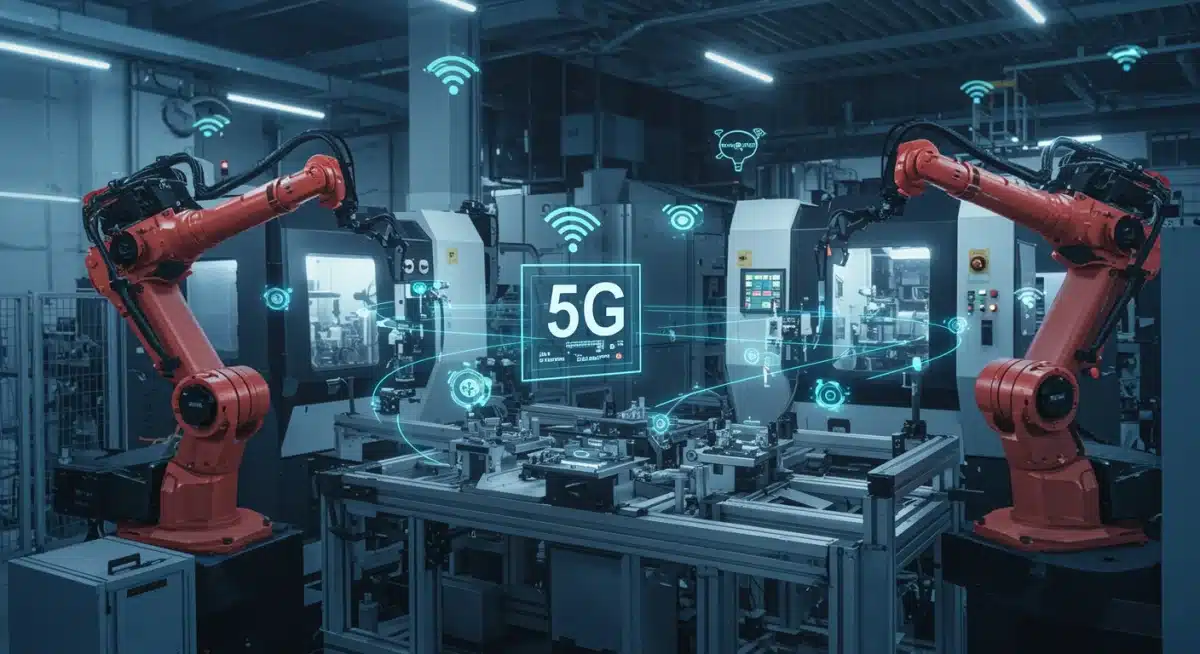
The factory floor is being redefined by 5G. URLLC enables real-time control of robotic systems, predictive maintenance through massive sensor data, and augmented reality (AR) for remote assistance and training. Network slicing allows manufacturers to dedicate private 5G networks to their facilities, ensuring unparalleled security and performance. This leads to increased automation, higher efficiency, reduced downtime, and more flexible production lines. The concept of the ‘smart factory’ is becoming a reality, largely powered by the advancements in 5G Evolution US networks.
Healthcare and Telemedicine
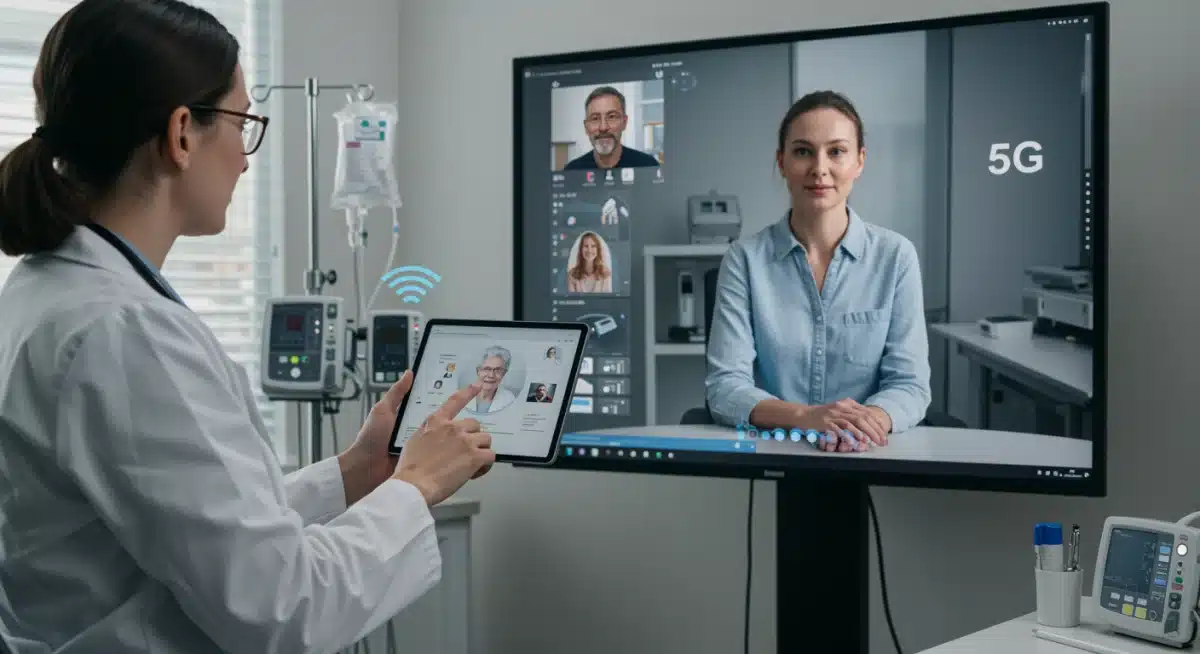
The healthcare sector is witnessing a paradigm shift. 5G’s low latency and high bandwidth are crucial for advanced telemedicine, enabling high-definition video consultations, remote diagnostics, and even robotic-assisted surgeries performed by surgeons miles away. Wearable devices for continuous health monitoring, powered by mMTC, transmit vital signs in real-time, allowing for proactive intervention. The ability to transfer large medical imaging files quickly and securely is also a significant advantage. By 2026, the 5G Evolution US will have made healthcare more accessible, efficient, and personalized.
Transportation and Logistics
Autonomous vehicles, smart traffic management systems, and advanced logistics are all beneficiaries of 5G. URLLC is indispensable for vehicle-to-everything (V2X) communication, allowing cars to communicate with each other, traffic infrastructure, and pedestrians, vastly improving safety and efficiency. Drones for delivery and surveillance are also becoming more viable with 5G’s reliable connectivity. Real-time tracking and optimization of supply chains are leading to significant cost savings and faster delivery times across the US, a testament to the ongoing 5G Evolution US.
Smart Cities and Public Safety
5G Evolution US is the backbone of smart city initiatives. Connected sensors monitor everything from air quality and waste management to traffic flow and public safety. Real-time data analytics enable cities to respond more efficiently to challenges and improve urban living. For public safety, 5G enhances emergency response with faster communication, real-time video feeds from incident sites, and advanced location services, providing first responders with critical information when seconds count.
Retail and Entertainment
In retail, 5G facilitates immersive augmented reality (AR) shopping experiences, personalized in-store guidance, and efficient inventory management through IoT devices. The entertainment industry benefits from enhanced mobile gaming, high-quality live streaming from anywhere, and the development of truly immersive virtual reality (VR) experiences without the need for cumbersome cables. The seamless delivery of rich content is a major driver for consumer adoption of 5G Evolution US technologies.
Economic Implications and Job Creation through 5G Evolution US
The economic impact of 5G Evolution US is profound and multi-faceted. Billions of dollars have been invested in infrastructure, creating thousands of jobs in construction, engineering, and telecommunications. Beyond direct investment, 5G acts as an economic accelerator, fostering innovation and creating entirely new industries and job categories. A report by Accenture estimated that 5G could add up to $1.5 trillion to US GDP and create up to 4.6 million jobs by 2030. By 2026, a significant portion of this growth will already be realized, as businesses leverage 5G to enhance productivity, create new products and services, and expand into new markets.
The increased efficiency and automation driven by 5G will boost productivity across all sectors. This, in turn, can lead to higher wages and a more competitive US economy on the global stage. Furthermore, the development of new 5G-enabled applications and services will spur entrepreneurship and attract further investment, creating a virtuous cycle of innovation and growth. The strategic importance of the 5G Evolution US cannot be overstated for national economic prosperity.
Challenges and Considerations for Continued 5G Evolution
Despite the immense progress, the 5G Evolution US journey is not without its hurdles. Several challenges need to be addressed to ensure its full potential is realized:
- Spectrum Availability and Allocation: While significant strides have been made, ensuring adequate and harmonized spectrum is crucial for sustained 5G expansion, particularly for mid-band spectrum which offers a good balance of speed and coverage.
- Infrastructure Deployment Costs and Permitting: The sheer scale of infrastructure required for ubiquitous 5G coverage, especially small cells, presents ongoing challenges related to cost, zoning regulations, and local permitting processes. Streamlining these processes is vital.
- Cybersecurity Concerns: With an exponentially greater number of connected devices and critical infrastructure relying on 5G, cybersecurity becomes paramount. Robust security protocols and continuous vigilance are essential to protect against cyber threats and ensure data integrity.
- Digital Divide: Ensuring equitable access to 5G across urban, suburban, and rural areas remains a significant challenge. Bridging the digital divide requires continued investment and innovative deployment strategies to prevent certain communities from being left behind in the 5G Evolution US.
- Interoperability and Standardization: As 5G networks mature and integrate with various devices and applications, ensuring seamless interoperability and adherence to global standards is critical for a cohesive and efficient ecosystem.
The Future Beyond 2026: What’s Next for 5G Evolution US?
By 2026, the foundation of 5G will be firmly established, but the evolution won’t stop there. The industry is already looking towards 5G-Advanced and eventually 6G. These future iterations will further enhance current capabilities and introduce entirely new ones, such as:
- Even Greater AI Integration: Future networks will be even more intelligent and self-optimizing, leveraging AI for network management, resource allocation, and predictive maintenance.
- Pervasive Sensing: The network itself will become a sensor, capable of detecting presence, movement, and even vital signs without dedicated devices, opening up new applications in smart environments and healthcare.
- Holographic Communication: While still in early research, truly immersive holographic communication could become a reality as network capabilities continue to advance.
- Sustainable Connectivity: Future generations of wireless technology will prioritize energy efficiency and sustainability, reducing the environmental footprint of global connectivity.
The journey of 5G Evolution US is a continuous one, promising an even more connected, intelligent, and efficient future for the nation.
Conclusion: 5G as a Catalyst for American Innovation
As we assess the state of 5G Evolution US in 2026, it’s clear that this technology is far more than just an upgrade; it’s a transformative force. From revolutionizing industrial operations and healthcare delivery to enabling smarter cities and unprecedented entertainment experiences, 5G is the critical infrastructure powering the next wave of American innovation and economic growth. While challenges remain, the commitment to investment and technological advancement ensures that the US will continue to lead in harnessing the full potential of 5G. Businesses, policymakers, and consumers alike must remain engaged and adaptable to fully capitalize on the immense opportunities that this evolving technology presents, shaping a future defined by ubiquitous, intelligent, and ultra-responsive connectivity.